
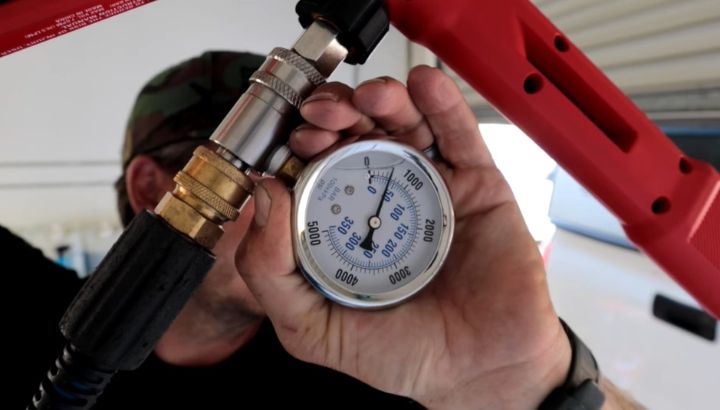
Swap color-coded nozzle tips to adjust pressure instantly on any electric pressure washer without tools. Wider spray angles like 40 degrees reduce surface impact force, while 15-degree tips concentrate it significantly. Increasing standoff distance reduces effective pressure on the surface without changing any machine settings. Some models include a pressure dial or adjustable unloader valve for direct PSI control.
Most electric pressure washers don’t have a simple dial you turn to change PSI output. Pressure adjustment works through nozzle selection, standoff distance, and in some models, a built-in regulator or variable pressure control.
Getting this wrong means etched concrete, raised wood grain, or stripped paint on surfaces that needed a lighter touch.
This guide covers every adjustment method available on consumer electric models, explains which approach works best for each surface type, and shows you how to dial in exactly the right pressure every session.
Why Pressure Adjustment Matters More Than Raw PSI Output
A machine rated at 2,000 PSI delivers maximum output only through the narrowest nozzle at minimum standoff distance. At that setting, it will strip softwood, etch stamped concrete, and remove paint from metal surfaces without warning.
The rated PSI number on the box describes the machine’s ceiling output, not the pressure you should use on every job. Every surface you clean has an ideal effective pressure range that sits somewhere below that ceiling, and adjusting down to that range is what produces professional results.
Understanding all available adjustment methods on your specific model gives you precise control across every cleaning task rather than forcing you to accept whatever the machine produces at its default setting.
The Difference Between Output Pressure and Effective Surface Pressure
Output pressure is what the pump generates at the nozzle tip. Effective surface pressure is the impact force the water stream delivers after traveling through the air and spreading across the contact area. These two numbers are never identical and diverge significantly as distance increases.
A 2,000 PSI output at 6 inches of standoff distance delivers far more surface impact than the same 2,000 PSI output at 24 inches. The water stream loses velocity and spreads as it travels through air, reducing the force delivered per square inch at the contact surface.
This relationship between output pressure and standoff distance is the foundation of the most practical and accessible pressure adjustment method available on any electric machine regardless of its features.
Why Electric Models Have Fewer Built-In Adjustment Options Than Gas Units
Gas pressure washers typically include an adjustable unloader valve that allows direct output PSI control through a physical knob or dial. Most consumer electric models rely instead on fixed-output pump assemblies paired with nozzle-based pressure control.
The engineering reason is cost and simplicity. A fixed-output pump with nozzle-controlled pressure reduction is less expensive to manufacture reliably than an adjustable pressure regulation system. It also has fewer failure points in the adjustment mechanism itself.
Premium electric models from Karcher and Ryobi have begun incorporating pressure dials and variable flow controls into their upper-tier residential machines. These features bring the direct adjustment convenience of gas units to the electric category for users who want that level of control.
Method One: Nozzle Tip Selection and the Color Code System
Nozzle selection is the primary and most effective pressure adjustment method on any electric pressure washer. The color-coded tip system allows instant pressure adjustment without tools, without settings menus, and without any machine modification.
How Nozzle Angle Controls Effective Pressure
The nozzle orifice concentrates the pump’s output flow into a specific spray pattern. A narrow angle like 0 or 15 degrees directs that flow into a small contact area, concentrating maximum energy per square inch at the surface.
A wide angle like 40 or 65 degrees spreads the same flow energy across a much larger contact footprint. The total energy output from the pump is identical regardless of tip, but the energy per square inch at the surface drops dramatically as angle increases.
This is why nozzle selection functionally adjusts surface pressure without changing anything about how the pump operates. The machine produces the same PSI at every tip, but the effective cleaning pressure at the surface changes completely based on the angle the water spreads across.
Complete Nozzle Selection Guide by Surface Type
| Nozzle Color | Spray Angle | Effective Surface Pressure | Recommended Surface |
|---|---|---|---|
| Red | 0 degrees | Maximum concentration | Rust stripping, concrete scaling only |
| Yellow | 15 degrees | Very high | Bare concrete, heavy masonry stains |
| Green | 25 degrees | Moderate to high | Driveways, brick, general outdoor surfaces |
| White | 40 degrees | Moderate | Wood, siding, vehicles, painted surfaces |
| Black | 65 degrees | Minimal | Soap application only |
Always start with the widest angle that might work for your surface and step narrower only if results are insufficient after a test pass. Moving from high pressure to low is always reversible. Surface damage from starting too narrow is not.
When to Step Down to a Wider Tip Mid-Session
If you observe grain raising on wood during a cleaning pass, switch immediately to the white 40-degree tip and increase standoff distance by at least 4 inches before continuing. Grain raising visible on the first pass means the current tip is concentrating too much energy at the wood fiber surface.
If you see paint lifting or surface coating removal on concrete, sealed stone, or brick during a pass, the current tip is too narrow for that specific surface coating. Switch up one color step and retest on an inconspicuous area before continuing across the full surface.
Method Two: Standoff Distance Adjustment
Standoff distance is the most continuously variable and precise pressure adjustment tool available on any electric machine. Unlike nozzle swapping, which changes pressure in discrete steps, standoff adjustment lets you fine-tune effective surface pressure infinitely within each nozzle’s range.
How Distance Reduces Effective Surface Pressure
Water exiting the nozzle tip immediately begins losing velocity to air resistance and begins spreading laterally as it travels toward the surface. At 6 inches of standoff, the stream retains most of its exit velocity and covers a small area. At 24 inches, it has lost significant velocity and covers a larger area.
Both factors work together to reduce effective pressure as distance increases. Lower velocity means less kinetic energy per water molecule at impact. Larger contact area means that energy is distributed across more surface per moment, reducing impact concentration further.
The practical effect is substantial. Moving from 6 inches to 18 inches of standoff with a green 25-degree tip delivers a dramatically gentler cleaning action that is appropriate for surfaces that would be damaged at the closer distance.
Standoff Distance Recommendations by Surface Category
| Surface Type | Nozzle | Minimum Standoff | Maximum Standoff | Notes |
|---|---|---|---|---|
| Bare concrete | Yellow or Green | 6 inches | 12 inches | Test for etching before full session |
| Sealed concrete | Green | 12 inches | 18 inches | Protect sealer coat |
| Wood decking | White | 18 inches | 24 inches | Work parallel to grain direction |
| Vinyl siding | White | 20 inches | 30 inches | Never spray upward under panels |
| Vehicle paint | White | 18 inches | 24 inches | Use car wash soap for best results |
| Outdoor furniture | White | 18 inches | 24 inches | Check material before reducing distance |
Adjusting standoff distance during a session is faster than swapping tips and allows real-time response to surface condition changes. Develop the habit of stepping back first when uncertain rather than stepping closer.
Method Three: Variable Pressure Controls on Equipped Models
Some electric pressure washers include mechanical or electronic pressure adjustment systems that allow direct output PSI control without changing nozzle tips. These systems represent the most convenient approach to how to adjust pressure on electric pressure washer models that include them.
Pressure Dials and Variable Flow Knobs
A pressure dial or variable flow knob on the machine body controls the output PSI directly by adjusting internal flow regulation between the pump outlet and the wand. Turning the dial toward lower settings reduces the PSI delivered to the nozzle, regardless of which tip is installed.
Models from Karcher including the K4 and K5 series incorporate pressure dial controls that allow smooth adjustment across the machine’s full output range. This allows users to set an exact pressure appropriate for each surface rather than selecting from the discrete steps that nozzle swapping provides.
The practical advantage is eliminating tip changes for minor pressure adjustments between surfaces. Moving from a deck surface to adjacent concrete steps requires only a dial adjustment rather than a full nozzle swap, save time and maintaining workflow continuity throughout the session.
Adjustable Unloader Valves on Advanced Models
An adjustable unloader valve controls the pressure at which the pump bypasses flow back to the inlet rather than directing it out through the wand. Adjusting the unloader valve spring tension directly changes the maximum output PSI the machine can produce.
This adjustment requires accessing the unloader valve body on the pump assembly, typically by removing a cap or retaining screw. It is not a session-by-session adjustment like a pressure dial but rather a configuration change that sets the machine’s output ceiling for extended use at a specific application.
Never adjust the unloader valve beyond the manufacturer’s specified range for your model. Increasing bypass pressure above design limits stresses pump seals, O-rings, and hose fittings beyond their rated pressure tolerance, creating leak points or complete seal failure under sustained high-pressure operation.
Variable Nozzle Wands: The All-in-One Adjustment Tool
Some Ryobi and Sun Joe models include a variable pressure wand that combines multiple nozzle angles into a single rotating tip assembly. Rotating the outer collar adjusts the spray pattern from a tight stream through progressively wider fan angles, effectively changing the effective surface pressure without tip swapping.
Variable nozzle wands provide convenient continuous adjustment but wear faster than fixed tip assemblies because the rotating collar mechanism experiences mechanical wear with every adjustment cycle. Inspect the collar seal and rotation mechanism at the start of each season and replace the variable assembly when the pattern no longer adjusts smoothly or when pressure drops noticeably at the tighter angle settings.
Method Four: Water Supply Pressure and Flow Rate Management
The water supply flowing into the machine influences output pressure in ways that many users overlook. An inadequate supply creates pump cavitation that reduces output below rated pressure, while a consistent full-flow supply allows the machine to deliver its designed output reliably.
How Supply Pressure Affects Output
Consumer electric pressure washers require a minimum supply flow rate to operate without cavitation. Most models specify a minimum inlet flow of 1 to 1.5 GPM and a minimum supply pressure of 20 PSI at the inlet port.
When supply pressure or flow falls below these minimums, the pump draws air through the inlet alongside water, creating cavitation that reduces output pressure, causes pulsating delivery, and accelerates internal pump wear. Confirming adequate supply is the first step when output pressure feels lower than normal.
A fully open tap, a kink-free supply hose with at least 5/8-inch internal diameter, and a clean inlet filter mesh screen are the three supply-side factors that ensure the pump receives the full flow it needs to produce rated output consistently.
Using Supply Restriction to Reduce Maximum Output
Some technicians reduce effective pump output by introducing a partial flow restriction at the supply inlet on machines without built-in pressure adjustment. This is not a recommended approach for most users because controlled restriction requires careful implementation to avoid damaging pump components through sustained cavitation.
Variable flow at the outlet through nozzle selection and standoff distance adjustment is always the preferred method for reducing effective pressure on consumer electric machines. Supply restriction should be reserved for professional service contexts where the technique is applied with appropriate equipment and monitoring.
Surface-Specific Pressure Adjustment Guide
Knowing how to adjust pressure on electric pressure washer equipment correctly for each surface type prevents the surface damage that occurs when maximum output is applied without consideration for material vulnerability.
Wood Surfaces: Decks, Fences, and Timber Structures
Wood is the most pressure-sensitive common cleaning surface. Softwoods including pine, cedar, and redwood begin showing grain raising and fiber damage at effective surface pressures that are well within the output range of most consumer electric models.
Use the white 40-degree nozzle exclusively on all wood surfaces. Hold at 18 to 24 inches minimum standoff distance and work parallel to the grain direction without pausing the wand at any single point. Pausing concentrates energy and raises grain locally, creating visible depressions in the surface that require sanding before refinishing.
Older weathered decking with no surface coating can tolerate slightly closer distances than sealed or finished wood. Sealed and stained wood surfaces require maximum standoff and the white tip to protect the existing coating from being stripped.
Concrete Surfaces: Driveways, Patios, and Walkways
Bare uncoated concrete tolerates the highest effective pressure of any standard residential cleaning surface. The green 25-degree nozzle at 10 to 16 inches handles most general cleaning effectively, and the yellow 15-degree tip at 8 to 12 inches addresses heavy staining and biological growth.
Sealed, stamped, or decorative concrete requires surface pressure reduction to protect the coating. Use the green nozzle at 14 to 18 inches rather than the yellow tip, and test on an inconspicuous corner before cleaning the full surface to confirm the sealer coat remains intact throughout.
Efflorescence, the white mineral deposit common on concrete and masonry, responds better to chemical pre-treatment with an acidic cleaner than to aggressive pressure alone. Apply the cleaner, allow full dwell time, then use the green tip at moderate distance to rinse rather than attempting to blast deposits off mechanically.
Vehicles, Boats, and Coated Surfaces
Automotive paint and marine gel coat are the most chemically complex and damage-sensitive surfaces most homeowners clean. Paint protection films, ceramic coatings, and gel coat finishes all have specific pressure tolerance limits that are well below the maximum output of any 2,000-plus PSI machine.
Use the white 40-degree nozzle at a minimum 18-inch standoff for all automotive surfaces without exception. Never use the green, yellow, or red tips on painted surfaces, coated metals, or fiberglass without testing on a hidden area first to confirm no coating lift occurs at the proposed distance.
Apply car wash soap through the soap nozzle or onboard detergent system and allow adequate dwell time before rinsing. Chemical action from the soap does most of the contamination removal work, reducing the pressure needed during the rinse phase and minimizing the mechanical stress on the paint surface.
Diagnosing and Fixing Pressure That Won’t Adjust Correctly
When Pressure Feels Too High Despite Wide Nozzle Use
If the white 40-degree nozzle at 24 inches still produces surface damage on a specific material, the machine’s output may be correct but the material requires soft washing rather than pressure washing. Soft washing uses very low-pressure chemical application rather than mechanical impact.
Check whether the machine’s unloader valve is set above factory specification if your model allows adjustment. A valve set too high prevents pressure from dropping to appropriate levels at wider nozzle angles and can indicate a previous unauthorized adjustment.
When Pressure Feels Too Low Despite Correct Settings
Reduced pressure across all nozzle tips after a period of normal operation indicates pump seal wear rather than an adjustment issue. Worn seals allow internal bypass that reduces output regardless of nozzle selection or standoff distance.
Check the inlet filter, confirm the supply tap is fully open, and inspect the nozzle tip for wear or partial blockage before suspecting pump seals. A nozzle tip with an enlarged orifice from wear allows more flow at reduced pressure, mimicking the symptom of a worn pump on a machine where the pump itself remains functional.
Frequently Asked Questions
How do I adjust pressure on an electric pressure washer without a dial?
Nozzle tip selection and standoff distance are the two adjustment methods available on machines without a built-in pressure dial. Switch to a wider angle tip to reduce effective surface pressure. Increase standoff distance from the surface to reduce impact force further within the same tip.
Most consumer electric machines use this nozzle-based system as the primary pressure control method. Start with the white 40-degree tip at 18 to 24 inches for any unfamiliar surface. Step to narrower tips and shorter distances only after confirming the surface tolerates increased pressure on a test area.
What is the safest nozzle to use for most residential cleaning tasks?
The white 40-degree nozzle is the safest all-purpose starting point for most residential surfaces. It delivers sufficient cleaning force for siding, vehicles, outdoor furniture, wood decks, and lightly soiled concrete while distributing that force widely enough to avoid surface damage on most materials.
The green 25-degree nozzle is the appropriate step up for concrete driveways and patios with moderate staining. The yellow 15-degree nozzle is for heavy concrete stains and bare masonry only. The red 0-degree nozzle should be used only on specific heavy-duty stripping tasks where surface damage is not a concern.
Can I damage a surface by adjusting to too high a pressure setting?
Yes. Excessive pressure causes permanent damage on many common surfaces that cannot be reversed without refinishing work. Wood grain raising from high-pressure spray requires sanding before any stain or sealer can be reapplied. Paint stripping from metal surfaces requires priming and repainting. Etching on decorative concrete requires sealer reapplication.
Always test any new surface on an inconspicuous area before committing to the full cleaning pass. This 30-second test reveals whether the current nozzle and distance combination is appropriate and costs nothing compared to refinishing a damaged surface.
Does adjusting standoff distance really make a significant pressure difference?
Yes, the effect is substantial and measurable. Moving from 6 inches to 18 inches of standoff distance with the same nozzle reduces effective surface pressure by 50 percent or more, depending on nozzle angle and machine output. The stream velocity drops and the contact area expands simultaneously, reducing impact force significantly.
This makes standoff distance the most precise continuous pressure adjustment tool available on any machine. Unlike nozzle swapping which changes pressure in discrete steps, standoff adjustment allows infinite fine-tuning within each nozzle’s effective range during an active cleaning session.
How do I adjust pressure on a Karcher electric pressure washer?
Karcher K4, K5, and K7 series models include a pressure dial on the machine body or on the trigger gun assembly that allows smooth PSI adjustment across the machine’s full output range. Rotate the dial toward the lower setting to reduce output pressure for delicate surfaces.
Some Karcher models also use a color-coded nozzle system compatible with the standard five-tip set. Using both the pressure dial and the appropriate nozzle together gives the most precise pressure control available on any consumer electric machine, allowing exact output matching to the surface requirements.
Why does my pressure feel inconsistent even with the correct nozzle installed?
Inconsistent pressure that varies rhythmically during a session indicates air entering the water supply, which causes pump cavitation. Reconnect all supply hose fittings, confirm the tap is fully open, check for kinks in the supply hose, and reprime the system by squeezing the trigger before powering on.
A worn nozzle tip with an enlarged orifice from abrasive particle wear produces inconsistent pressure by allowing variable flow bypass around the orifice edge. Replace any tip that shows visible wear at the orifice or that produces noticeably softer pressure than a new tip of the same color code.
Can I use a pressure regulator attachment to reduce electric pressure washer output?
Yes. Inline pressure regulators that attach between the pump outlet and the high-pressure hose reduce output PSI to a preset level. These accessories are useful for delicate cleaning tasks where even the widest nozzle at maximum standoff produces more pressure than the surface can safely tolerate.
Inline regulators designed for pressure washer use typically allow adjustment between 500 and 2,000 PSI output. Confirm the regulator’s rated maximum input pressure exceeds your machine’s output to prevent over-pressurization of the regulator body itself, which can cause failure or inaccurate pressure delivery during operation.
What is the correct pressure for cleaning a wood deck?
Effective surface pressure for wood deck cleaning should fall between 500 and 800 PSI at the surface for most softwood decking materials. Achieving this on a 2,000 PSI machine requires the white 40-degree nozzle at 18 to 24 inches of standoff distance, which reduces effective pressure to the appropriate range.
Hardwood decking including ipe, teak, and composite materials tolerates slightly higher effective pressure but still requires the white tip as the minimum appropriate nozzle. Never use the green or yellow tip directly on any wood deck surface regardless of how weathered or heavily stained the surface appears.
Should I adjust to lower pressure when using detergent?
Yes, always apply detergent at low pressure using the black 65-degree soap nozzle or the machine’s onboard detergent tank system. High-pressure soap application forces concentrated chemical into surface pores and joints where it is difficult to rinse completely, and it also aerosolizes the solution into fine droplets that create chemical exposure risk.
Low-pressure soap application through the black tip or downstream injection system allows even coverage that clings to the surface during the required dwell period. Switch to the appropriate rinse nozzle for the surface only after the detergent has had adequate contact time to break down surface contamination chemically.
Conclusion
Pressure adjustment on electric pressure washers works through three practical methods: nozzle tip selection, standoff distance management, and direct pressure controls on equipped models.
Nozzle swapping provides immediate, discrete adjustments. Standoff distance provides continuous fine-tuning within each tip’s range. Built-in dials and variable wands provide the most convenient real-world control on models that include them.
The correct approach to how to adjust pressure on electric pressure washer equipment always starts at the widest available nozzle and greatest standoff distance, then steps toward higher pressure only after confirming the surface tolerates it on a test strip.
Match nozzle to surface, test before committing to a full pass, and use standoff distance for continuous fine-tuning. These three habits deliver professional-quality results on every surface without the damage that comes from defaulting to maximum pressure on every job.