
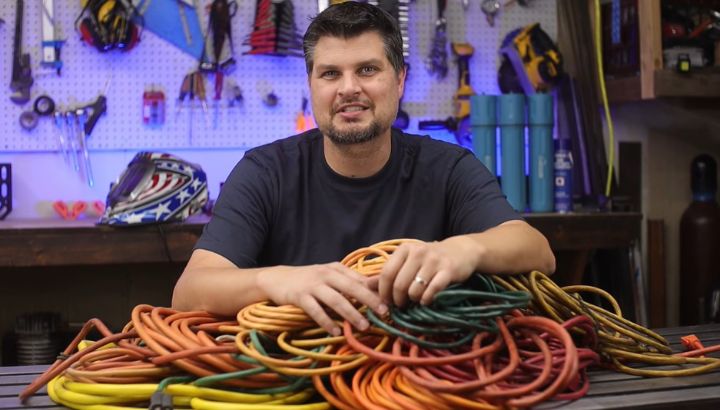
Yes, using an extension cord with an electric pressure washer is safe with 12-gauge outdoor-rated wire under 25 feet. Undersized cords cause voltage drop that overheats the motor and trips circuit breakers mid-session. Never use a 16-gauge indoor cord on machines drawing over 1,500 watts. Use a GFCI-protected outlet and keep all cord connections elevated off wet ground.
Reaching an outdoor outlet from a long driveway or around a house corner often makes an extension cord the only practical option. The answer is yes, but the cord specifications matter more than most users realize.
 HUANCHAIN 12 Gauge Heavy Duty Outdoor...
|
 POWGRN 100 FT 12/3 Outdoor Extension Cord...
|
POWGRN 100 FT 12/3 Outdoor Extension Cord...
|
Using the wrong gauge or length silently degrades motor performance, causes unexplained breaker trips, and shortens motor service life across every session. This guide covers correct gauge selection by machine wattage, safe maximum lengths, outdoor rating requirements, GFCI safety, and the exact symptoms that tell you your current cord is the problem.
Why Extension Cord Compatibility Matters for Electric Pressure Washers

Electric pressure washers are high-current appliances that draw sustained electrical load for 30 to 90 minutes per session. Unlike low-draw devices where cord quality barely matters, a pressure washer running at 1,800 watts stresses every component in the power delivery chain simultaneously.
The extension cord between the wall outlet and the machine is not a passive connector. It is a length of wire with measurable resistance that drops voltage under load. That voltage drop has direct consequences for motor health and operational reliability on every session where an inadequate cord is used.
Understanding why these consequences occur makes the gauge and length requirements logical rather than arbitrary. The rules exist because the physics of resistance and current are fixed, not negotiable.
What Voltage Drop Does to Your Motor
Voltage drop occurs when current flowing through the cord’s resistance converts electrical energy to heat rather than delivering it to the motor. As cord length and resistance increase, more voltage is lost before reaching the machine’s input terminals.
When the motor receives voltage below its rated input, it draws higher current to compensate and maintain output. Higher current generates additional heat in the motor windings, accelerating insulation degradation with every session the undersized cord is used.
The motor also runs less efficiently under low voltage, producing reduced pump output. This symptom appears as unexplained pressure loss that users incorrectly attribute to pump wear when the actual cause is the extension cord in use.
Wire Gauge: The Most Critical Extension Cord Specification
Wire gauge is the single most important specification when selecting an extension cord for pressure washer use. It determines the cord’s current-carrying capacity and resistance per foot of length.
The AWG system, which stands for American Wire Gauge, uses numbers that run inversely to wire size. Lower numbers mean thicker wire with less resistance. Higher numbers mean thinner wire with more resistance per foot.
For pressure washer use, this means 12-gauge wire is better than 14-gauge, which is better than 16-gauge. The difference between these options under a sustained 1,800-watt load is significant and measurable in voltage delivery quality.
Understanding AWG Wire Gauge Numbers
A 12-gauge cord carries approximately 20 amps safely for the lengths used in residential outdoor applications. A 14-gauge cord carries approximately 15 amps. A 16-gauge cord carries approximately 13 amps.
Consumer electric pressure washers drawing 1,800 watts at 120 volts pull 15 amps continuously. A 16-gauge cord rated for 13 amps sustained is already undersized at the machine’s rated draw before any length-related resistance is added to the calculation.
A 14-gauge cord meets the current rating requirement marginally but has higher resistance per foot than 12-gauge. For runs beyond 15 feet, the added resistance begins producing measurable voltage drop on machines drawing 1,500 watts or more.
12-Gauge Versus 14-Gauge Versus 16-Gauge: Practical Comparison
| Wire Gauge | Max Safe Amps | Resistance per 100 ft | Safe for 1,800W Machine | Maximum Recommended Length |
|---|---|---|---|---|
| 10-gauge | 30 amps | 0.10 ohms | Yes, excellent | 100 feet |
| 12-gauge | 20 amps | 0.16 ohms | Yes, recommended | 25 to 50 feet |
| 14-gauge | 15 amps | 0.25 ohms | Marginal under 15 feet | 15 feet maximum |
| 16-gauge | 13 amps | 0.40 ohms | No, undersized | Not recommended |
| 18-gauge | 10 amps | 0.64 ohms | No, dangerous | Never use |
The 12-gauge cord is the correct minimum for any machine drawing 1,500 watts or more at any length up to 25 feet. Beyond 25 feet, step up to 10-gauge to maintain adequate voltage delivery under sustained full load.
Maximum Safe Length and How Distance Affects Performance
Cord length multiplies the voltage drop effect because resistance accumulates with every additional foot of wire in the circuit. A cord that performs adequately at 15 feet may cause significant voltage drop at 50 feet of identical gauge.
The relationship is linear. Double the length and you double the resistance in that cord. At full motor load, doubling the resistance doubles the voltage lost to the cord rather than delivered to the machine’s input terminals.
This is why length and gauge must be evaluated together rather than independently. A 12-gauge cord at 75 feet causes more voltage drop than a 10-gauge cord at the same length, but less than a 14-gauge cord at 50 feet.
How Length Multiplies Voltage Drop
Current flowing through the circuit travels both ways along the cord, down the hot conductor and back along the neutral conductor. The effective resistance the motor experiences is the round-trip resistance of both conductors combined.
A 25-foot cord adds 50 feet of actual conductor to the circuit when both directions are counted. A 50-foot cord adds 100 feet of effective conductor resistance. This doubling effect accelerates as cord length increases and explains why length limits exist even for heavy-gauge cords.
The National Electrical Code uses a 3 percent maximum voltage drop guideline for branch circuit conductors. For a 120-volt circuit, this means no more than 3.6 volts should be lost in the cord under full load. Standard 12-gauge wire at 25 feet with a 15-amp load drops approximately 2.5 volts, remaining within this guideline comfortably.
Maximum Length Recommendations by Machine Wattage
| Machine Wattage | Amperage Draw | 12-Gauge Max Length | 10-Gauge Max Length | 14-Gauge Max Length |
|---|---|---|---|---|
| 1,200 W | 10 amps | 50 feet | 100 feet | 25 feet |
| 1,500 W | 12.5 amps | 35 feet | 75 feet | 15 feet |
| 1,800 W | 15 amps | 25 feet | 50 feet | Not recommended |
| 2,000 W | 16.7 amps | 20 feet | 40 feet | Not recommended |
These lengths represent the maximum for maintaining voltage drop within the 3 percent guideline. Shorter is always better. If the outlet location allows it, running the machine directly from the wall outlet without any extension cord is the optimal configuration for every machine at every wattage level.
Outdoor Rating and Safety Requirements
Not all extension cords are designed for outdoor use, and the distinction matters for both performance and safety in pressure washing applications. Outdoor-rated cords carry specific design features that indoor cords lack.
The outer jacket of an outdoor-rated extension cord is made from materials that resist UV degradation, moisture absorption, and temperature extremes. Indoor cord jackets use softer materials that crack and degrade when exposed to sunlight, wet grass, and the temperature cycling of outdoor use.
A cracked or degraded cord jacket is not merely an aesthetic issue. It exposes the conductors inside to moisture contact, which creates ground fault conditions that trip the GFCI outlet and can create shock hazards in wet operating environments.
Outdoor Versus Indoor Cord Rating Differences
Outdoor-rated extension cords carry a letter designation in their specification code that indicates environmental suitability. The letter W in the cord’s type designation indicates it is rated for outdoor use in wet conditions.
Common outdoor-rated cord designations include SJTW, SJTOW, and STW. The W suffix confirms wet-location suitability. Indoor-only cord types including SJT and SPT lack this designation and are not approved for outdoor use regardless of how well they appear to perform initially.
Always check the cord’s type designation before purchasing for pressure washer use. A cord sold in the outdoor section of a hardware store is not automatically outdoor-rated unless the designation is confirmed on the cord’s label or specification tag.
Three-Prong Grounded Cords Are Non-Negotiable
Any extension cord used with a pressure washer must carry three prongs including the grounding pin. Two-prong cords lack the equipment grounding conductor that carries fault current safely to ground rather than through the user’s body in a fault event.
Electric pressure washers are class I appliances with metal components that require grounding for safe operation. The third pin connects the machine’s metal housing to the grounding system, ensuring that a wiring fault inside the machine trips the GFCI or breaker rather than energizing the housing.
Never use an adapter that removes the third prong to fit a two-prong outlet. This defeats the entire grounding protection system and creates an unmitigated electrocution hazard that no other precaution can compensate for.
GFCI Protection and Electrical Safety in Wet Conditions
The answer to can you use extension cord with electric pressure washer safely in outdoor wet conditions depends partly on GFCI protection being present in the circuit. GFCI protection is not optional for outdoor pressure washer use under any circumstances.
A GFCI device interrupts circuit power within 25 milliseconds when it detects a current imbalance as small as 5 milliamps between live and neutral conductors. This imbalance indicates current is escaping the intended circuit path, which occurs when moisture contacts damaged cord insulation or when a machine fault develops.
Without GFCI protection, a fault condition that would cause a brief nuisance trip becomes a sustained current flow that can cause ventricular fibrillation within seconds of contact. GFCI devices cost under $20 and are available as outlet replacements or as inline cord-end adapters for use with unprotected outlets.
GFCI Requirements for Outdoor Cord Use
All outdoor residential electrical outlets installed since the late 1970s are required to be GFCI-protected under the National Electrical Code. Confirm GFCI protection by pressing the test button on the outlet face, verifying the outlet loses power, then pressing reset and verifying power restores.
A GFCI that does not hold its reset indicates either an outlet fault or an existing ground fault in the connected equipment. Do not attempt to operate any equipment on an outlet that will not hold a GFCI reset.
If the only available outdoor outlet is not GFCI-protected, use a portable GFCI inline adapter between the outlet and the extension cord. These adapters provide the same protection as a built-in GFCI outlet and are appropriate temporary solutions for outlets that cannot be immediately upgraded.
Keeping Connections Elevated Off Wet Ground
The junction between the extension cord and the machine’s power cord is the most vulnerable electrical connection point during wet-condition pressure washing. Rain, overspray, and ground moisture can enter this connection if it rests on wet concrete, wet grass, or in a puddle.
Use a weatherproof cord connection housing or a commercially available cord lock cover to protect this junction. These inexpensive accessories seal around the joined plugs and prevent water entry from any direction.
Position the cord connection point at least 12 to 18 inches above the ground by looping it over a hook, railing, or elevated bracket. This elevation keeps the connection away from ground-level moisture and reduces the risk of current leakage that would trip the GFCI during normal operation.
Matching Extension Cord to Machine Wattage
Different Ryobi, Sun Joe, Greenworks, and Karcher models draw different sustained wattage during operation. Selecting the correct cord requires knowing the machine’s exact amperage draw rather than estimating from PSI rating alone.
The amperage draw appears on the motor housing specification label. Multiply amps by 120 volts to calculate running watts if the wattage is not listed directly. This number determines both the minimum gauge and the maximum safe length for the extension cord.
Cord Specifications by Machine PSI Tier
Light-duty models including Sun Joe SPX1000 and similar units rated under 1,600 PSI typically draw 10 to 12.5 amps. A 14-gauge outdoor cord up to 15 feet works adequately at this draw level. A 12-gauge cord up to 35 feet provides comfortable headroom for slightly longer runs.
Mid-range models including Ryobi RY141820 and Greenworks 2000 PSI units draw 13 to 15 amps continuously. These machines require 12-gauge cord exclusively for any run over 10 feet. 14-gauge cord should not be used at any length with machines in this amperage range.
High-output models including Karcher K5 and similar units drawing 15 to 17 amps require 12-gauge cord for runs up to 20 feet and 10-gauge cord for any run between 20 and 50 feet. These machines are best operated from a dedicated outlet without any extension cord whenever the outlet location permits.
Symptoms That Confirm Your Extension Cord Is the Problem
Cord-related performance problems are frequently misdiagnosed as machine faults because the symptoms appear at the machine rather than the cord. Knowing the specific symptom pattern caused by extension cord problems allows correct diagnosis without unnecessary parts replacement.
Performance Symptoms from Voltage Drop
Reduced output pressure that cannot be restored by cleaning the inlet filter or replacing the nozzle tip may indicate voltage drop rather than pump wear. When the motor receives reduced voltage, it produces reduced pump output. This symptom appears gradually as the cord degrades or manifests immediately if a cord that was always undersized is used for the first time.
The machine may also feel less powerful at full trigger squeeze without any obvious cause. Test by running the machine directly from the wall outlet without the extension cord. If pressure returns to normal on the direct connection, the cord is confirmed as the cause.
Electrical Symptoms from Undersized Cords
A circuit breaker that trips during the startup surge of the machine but not during steady running indicates the startup current combined with the cord’s resistance exceeds the breaker’s trip threshold momentarily. Switching to a heavier gauge cord reduces the current spike the breaker sees during motor acceleration.
A GFCI that trips during operation in dry conditions without any obvious moisture contact near the cord or outlet may indicate the cord is generating enough heat under load to degrade its insulation and create a minor current leakage path. Replacing the cord with a correctly rated unit resolves this symptom if the machine itself tests fault-free on a direct outlet connection.
Frequently Asked Questions
Can you use an extension cord with an electric pressure washer safely?
Yes, you can use an extension cord with an electric pressure washer safely provided the cord is the correct gauge, rated for outdoor use, no longer than the recommended maximum for the machine’s amperage draw, and connected through a GFCI-protected outlet.
The correct minimum gauge for any machine drawing over 1,500 watts is 12-gauge AWG. Cords should be outdoor-rated with a W suffix in their type designation, carry three prongs including the grounding pin, and be kept as short as practically possible. Running the machine directly from the wall outlet without any extension cord is always the optimal configuration when the outlet location permits it.
What gauge extension cord do I need for a pressure washer?
Use a minimum 12-gauge outdoor-rated extension cord for any pressure washer drawing 1,500 watts or more continuously. 12-gauge cord handles up to 20 amps safely and maintains adequate voltage delivery at lengths up to 25 feet under sustained high-current load.
For machines drawing under 1,200 watts, 14-gauge cord works adequately at lengths up to 15 feet. For any run longer than 25 feet on a machine drawing over 1,500 watts, step up to 10-gauge cord to maintain voltage within the 3 percent drop guideline. Never use 16-gauge or lighter cord on any pressure washer regardless of run length.
How long can the extension cord be for a pressure washer?
Maximum safe extension cord length depends on both wire gauge and machine amperage. A 12-gauge cord can run up to 25 feet safely on a machine drawing 15 amps. A 10-gauge cord extends this to 50 feet at the same current draw.
For machines drawing under 12.5 amps, 12-gauge cord can run up to 35 feet safely. Beyond 50 feet, voltage drop becomes significant even with 10-gauge cord, and a dedicated outlet installation near the work area is the more appropriate solution than an extremely long extension cord of any gauge.
Why does my pressure washer trip the breaker when using an extension cord?
A breaker trip caused by the extension cord occurs when the startup surge current of the motor, amplified by the cord’s resistance, exceeds the breaker’s trip threshold. The cord adds resistance to the circuit, which forces the motor to draw more current during the startup acceleration period.
Replacing the extension cord with a heavier gauge or shorter cord reduces the circuit resistance and the current spike the breaker experiences at startup. Testing by connecting the machine directly to the wall outlet without any extension cord confirms whether the cord is the cause. If the machine starts without tripping on the direct connection, the cord is the problem.
Can I use a 100-foot extension cord with a pressure washer?
A 100-foot cord is not recommended for any consumer electric pressure washer drawing over 1,000 watts. Even with 10-gauge wire, a 100-foot run on a 15-amp machine produces voltage drop that approaches the 3 percent guideline limit, leaving no margin for additional resistance from worn connectors or conductor joints.
For situations where the outlet is genuinely 100 feet from the work area, the appropriate solution is installing a dedicated outdoor outlet closer to the work location rather than using an extremely long extension cord. An electrician can install a weatherproof outdoor GFCI outlet for $150 to $300, permanently resolving the distance problem without the ongoing performance compromise of a very long cord.
Is it safe to use an extension cord in wet conditions with a pressure washer?
Yes, with specific precautions in place. The cord must be outdoor-rated with a W designation in its type code, confirming the jacket material is designed for wet-location use. The connection junction between the extension cord and machine cord must be elevated off the ground and protected with a weatherproof connection housing.
Connect through a GFCI-protected outlet before use. Test the GFCI by pressing the test and reset buttons to confirm it functions correctly. Do not allow the cord to rest in puddles or standing water. Inspect the cord jacket for any cracking, cuts, or damaged areas before every session.
What happens if I use a 16-gauge extension cord with my pressure washer?
A 16-gauge cord used on a machine drawing 1,500 watts or more creates three simultaneous problems. The cord operates above its safe current rating, which generates heat in the conductor and jacket material. Voltage drop on the undersized wire reduces voltage at the motor terminals below rated input. The motor draws elevated current to compensate, generating additional heat in both the cord and the motor windings.
Over multiple sessions, this combination shortens motor service life, degrades the cord jacket through heat buildup, and may eventually cause the cord jacket to soften or melt near the outlet end where current entry resistance is highest. Replace 16-gauge cords immediately with 12-gauge outdoor-rated alternatives.
Do all electric pressure washers require a GFCI outlet when using an extension cord?
Yes. All electric pressure washers used outdoors require a GFCI-protected circuit regardless of whether an extension cord is used. The GFCI is the primary protection against electrocution from ground fault conditions created by moisture contact with the cord, outlet, or machine housing.
If the available outlet is not GFCI-protected, use a portable GFCI inline adapter between the outlet and extension cord. These adapters are available at any hardware retailer for under $20 and provide equivalent protection to a built-in GFCI outlet. Test the GFCI adapter using its test and reset buttons before every session in wet conditions.
Why does my pressure washer lose pressure when using an extension cord?
Pressure loss when using an extension cord and normal pressure when connected directly to the wall outlet confirms voltage drop as the cause. The cord’s resistance is reducing voltage at the motor terminals below the rated input, causing the motor to produce reduced pump output.
Check the cord gauge against the machine’s amperage draw. If the cord gauge is below 12-gauge on a machine drawing over 1,200 watts, replace it immediately. If the cord is already 12-gauge, measure the cord length. A cord exceeding 25 feet on a high-draw machine may be causing marginal voltage drop that becomes noticeable as pump pressure reduction. Shortening the cord or upgrading to 10-gauge resolves the issue.
Conclusion
The question of can you use extension cord with electric pressure washer has a clear yes answer provided three requirements are met: 12-gauge minimum wire for machines drawing over 1,500 watts, outdoor-rated jacket with W designation, and length within 25 feet for 12-gauge cord.
Voltage drop is the underlying issue that every specification rule exists to prevent. Undersized gauge, excessive length, and damaged insulation all increase resistance and reduce voltage at the motor in ways that cause real and cumulative damage across repeated sessions.
GFCI protection, three-prong grounding, and keeping cord connections elevated off wet ground complete the safety requirements. Meet all five of these conditions and extension cord use introduces no additional risk or performance compromise to any residential pressure washing session.