
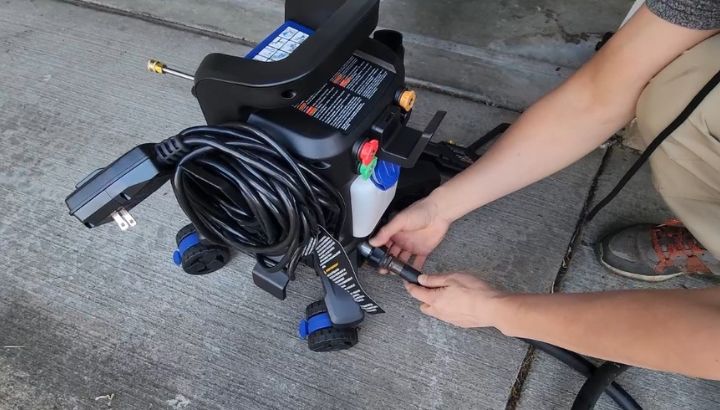
Most electric pressure washers use between 1,200 and 2,000 watts during normal operation. Compact models under 1,500 PSI typically draw 1,200 to 1,400 watts on a standard 15-amp household circuit. High-output models above 2,000 PSI draw 1,700 to 2,000 watts and may require a dedicated circuit to avoid tripping breakers. Generator use requires at least 2,500 surge watts to handle motor startup draw safely.
Knowing how many watts does an electric pressure washer use matters for three practical reasons: choosing the right circuit, sizing a generator correctly, and understanding your electricity cost. Most homeowners assume any outdoor outlet handles the job automatically, but a 2,000-watt machine on an overloaded circuit trips breakers mid-session and risks motor damage from voltage drop. This guide covers wattage ranges by model tier, startup versus running draw, circuit requirements, generator sizing, and real electricity cost calculations so you make the right decisions before you plug in.
Why Wattage Matters More Than PSI When Choosing a Circuit
Most buyers compare pressure washers by PSI and GPM. Those numbers describe cleaning output. Wattage describes electrical demand, and that is the number your circuit, outlet, and generator care about exclusively.
A machine rated at 2,000 PSI may draw anywhere from 1,400 to 1,800 watts depending on pump efficiency, motor design, and whether the motor is brushed or brushless. Two machines with identical PSI ratings can have meaningfully different wattage demands based on those internal engineering choices.
Understanding wattage before purchase prevents the frustrating situation of buying a capable machine and then discovering it trips your garage circuit every time the motor ramps up under load.
Running Watts Versus Startup Surge Watts
Electric motors draw significantly more current at startup than during steady-state running. This surge lasts only 1 to 3 seconds but can be 2 to 3 times the rated running wattage. A machine with a 1,500-watt running draw may surge to 3,000 watts for the brief moment the motor accelerates to operating speed.
Running watts are the continuous wattage the machine consumes during active cleaning. Startup surge watts are the peak wattage demand during motor acceleration. Both numbers matter, but for different reasons.
Running watts determine circuit loading during extended operation. Startup surge watts determine whether a circuit breaker trips on startup and whether a generator can handle the machine at all.
How to Find the Wattage Specification for Your Machine
The wattage rating appears on the machine’s specification label, usually on the motor housing or the back of the unit near the power cord entry point. It may be listed as watts directly, or as amps combined with voltage, which you convert by multiplying amps by volts.
A label reading 15A at 120V means the machine draws 1,800 watts at full load. A label reading 12.5A at 120V means 1,500 watts. This conversion handles any machine where watts are not listed explicitly.
If the specification label is absent or unreadable, the product manual and manufacturer website both carry the electrical specification. Never estimate wattage from PSI alone, as the correlation between output pressure and electrical draw is not consistent across different designs.
Wattage Ranges by Pressure Washer Category
Consumer electric pressure washers fall into three clear wattage tiers that align with their PSI output range and intended application. Knowing which tier your machine occupies tells you exactly what circuit and generator requirements apply.
Light-Duty Models: 1,200 to 1,500 Watts
Entry-level machines rated between 1,300 and 1,600 PSI typically draw 1,200 to 1,500 watts during continuous operation. These units run comfortably on any standard 15-amp household circuit without loading the circuit beyond safe operating margins.
Models in this category include compact units from Sun Joe and Greenworks designed for vehicles, outdoor furniture, and light surface cleaning. Their moderate wattage demand means they share a circuit with other modest loads without issue in most residential installations.
Startup surge on these machines typically peaks at 2,000 to 2,400 watts for the brief motor acceleration period. Any standard 15-amp circuit handles this surge without tripping under normal conditions.
Mid-Range Models: 1,500 to 1,800 Watts
Mid-range machines rated between 1,800 and 2,200 PSI draw 1,500 to 1,800 watts under continuous load. These units are capable of cleaning concrete driveways, deck surfaces, and siding efficiently, and their wattage demand approaches the practical limit of a shared 15-amp circuit.
Ryobi and Karcher both place their core residential models in this wattage tier. At 1,800 watts on a 15-amp circuit rated at 1,800 watts maximum continuous load, the machine is running at or near circuit capacity with no margin for any additional load on the same circuit.
Dedicated circuit use is strongly recommended for machines in this tier. A 20-amp circuit rated at 2,400 watts continuous provides comfortable headroom and eliminates the risk of nuisance tripping during extended cleaning sessions.
High-Output Models: 1,800 to 2,000 Watts
The top tier of consumer electric pressure washers, rated above 2,200 PSI, draws 1,800 to 2,000 watts continuously. These machines push the limits of what standard residential wiring can sustain without circuit upgrades or dedicated installation.
Startup surge on these models peaks at 3,000 to 3,500 watts during motor acceleration. On a shared 15-amp circuit, this surge trips the breaker before the machine reaches operating speed in many installations, creating the frustrating situation where the machine appears faulty when the issue is actually the circuit.
A dedicated 20-amp circuit is not optional for machines in this tier. It is the minimum electrical infrastructure that allows the machine to operate reliably without nuisance tripping under normal startup and running conditions.
Circuit Requirements for Safe and Reliable Operation
Matching the machine’s wattage demand to the appropriate circuit prevents the most common electrical frustrations that pressure washer owners encounter. Circuit sizing is straightforward once you understand the basic principles.
Standard 15-Amp Circuit Capacity and Limitations
A standard 15-amp residential circuit operates at 120 volts and delivers a maximum of 1,800 watts of continuous power. The National Electrical Code recommends loading circuits to no more than 80 percent of rated capacity for continuous loads, which limits a 15-amp circuit to 1,440 watts of sustained load in practice.
Any machine drawing more than 1,440 watts continuously on a 15-amp circuit is technically operating beyond the recommended continuous load threshold. In practice, breakers tolerate brief overloads, but sustained operation above this threshold generates heat in the breaker and wiring that shortens component life over time.
Reserve 15-amp circuits for machines drawing under 1,400 watts continuously. For any machine drawing more, a 20-amp circuit is the correct installation.
When a Dedicated Circuit Becomes Necessary
A dedicated circuit serves only one outlet with no other loads sharing the breaker. For pressure washers drawing 1,600 watts or more, a dedicated 20-amp circuit eliminates the startup surge tripping problem and prevents the motor voltage drop that occurs when a heavily loaded shared circuit cannot sustain rated voltage under peak demand.
Installing a dedicated outdoor GFCI outlet on a 20-amp circuit is a straightforward project for a licensed electrician and typically costs $150 to $300 including materials. That investment eliminates circuit-related frustrations permanently and protects the machine’s motor from the voltage drop damage that undersized circuits cause across repeated operating sessions.
GFCI Requirements for Outdoor Pressure Washer Circuits
All outdoor circuits in residential installations require GFCI protection under current electrical codes. GFCI protection is not optional for pressure washer use regardless of machine wattage. It is the safety device that prevents electrocution when water contacts the power cord, outlet, or machine housing in wet operating conditions.
Test the GFCI outlet before every session using the test and reset buttons on the outlet face. A GFCI that does not hold its reset after testing indicates either a wiring fault in the outlet itself or a fault condition in the pressure washer that requires diagnosis before any further operation.
Wattage Comparison Across Popular Models
| Model | Rated Watts | Amps | PSI Rating | Recommended Circuit | Startup Surge Estimate |
|---|---|---|---|---|---|
| Sun Joe SPX3000 | 1,800 W | 14.5A | 2,030 | 20-amp dedicated | 3,200 W |
| Greenworks 1700 PSI | 1,500 W | 12.5A | 1,700 | 15-amp or 20-amp | 2,600 W |
| Ryobi RY141820 | 1,800 W | 13A | 1,800 | 20-amp dedicated | 3,000 W |
| Karcher K5 Premium | 2,000 W | 13A | 2,000 | 20-amp dedicated | 3,500 W |
| Worx WG629 | 1,600 W | 13.3A | 1,600 | 15-amp or 20-amp | 2,800 W |
| Westinghouse ePX3050 | 1,800 W | 15A | 2,050 | 20-amp dedicated | 3,200 W |
The pattern across this table is consistent: machines rated above 1,700 PSI draw 1,800 watts or more continuously and benefit directly from a dedicated 20-amp circuit. Machines under 1,700 PSI with draws below 1,500 watts operate comfortably on a standard shared 15-amp circuit in most residential installations.
Running an Electric Pressure Washer on a Generator
Generator use introduces the startup surge wattage as the critical sizing factor rather than running wattage alone. A generator sized only for running watts trips its overload protection every time the pressure washer motor starts, making the generator appear undersized when it is actually only improperly matched.
How to Calculate the Generator Size You Need
Identify the machine’s running watts from the specification label or manufacturer documentation. Multiply the running wattage by 2 to estimate the startup surge requirement. This calculation gives a conservative surge estimate that most consumer electric pressure washer motors fall within.
A machine drawing 1,800 watts continuously requires a generator capable of at least 3,600 surge watts and 1,800 running watts. The generator’s published surge wattage rating must exceed the calculated startup demand for reliable startups without overload trips.
Add 15 to 20 percent margin above the calculated requirement when selecting a generator for pressure washer use. This buffer handles motor aging, line loss in the extension cord between generator and machine, and any additional small loads that might share the generator during a cleaning session.
Generator Sizing Reference Table
| Pressure Washer Wattage | Minimum Generator Running Watts | Minimum Generator Surge Watts | Recommended Generator Size |
|---|---|---|---|
| 1,200 W | 1,500 W | 2,400 W | 2,500 W generator |
| 1,500 W | 1,800 W | 3,000 W | 3,500 W generator |
| 1,800 W | 2,200 W | 3,600 W | 4,000 W generator |
| 2,000 W | 2,500 W | 4,000 W | 4,500 W generator |
Inverter generators are particularly well-suited for pressure washer use because they produce clean sine wave power that matches utility grid quality. Standard open-frame generators produce power with voltage variation under load that can stress brushless motor controllers over time.
Extension Cord Impact on Effective Wattage Delivery
An undersized extension cord between the generator and machine creates voltage drop under load. When voltage drops below the motor’s rated input, the motor draws higher current to compensate, which increases actual watt consumption and generates excess heat in the motor windings.
Use only 12-gauge outdoor-rated extension cords no longer than 25 feet for any machine drawing more than 1,500 watts. For runs beyond 25 feet, step up to 10-gauge cord to maintain adequate voltage delivery at the machine input terminals under full load.
Electricity Cost: What Does Running a Pressure Washer Actually Cost?
Understanding the operating cost of a pressure washer session helps with both budgeting and the practical decision of how long to run the machine per session. The calculation is straightforward with the correct input values.
Calculating Cost Per Hour of Operation
Divide the machine’s wattage rating by 1,000 to convert to kilowatts. Multiply kilowatts by the local utility rate per kilowatt-hour to calculate cost per hour of continuous operation.
A machine drawing 1,800 watts equals 1.8 kilowatts. At a utility rate of $0.14 per kilowatt-hour, the operating cost is 1.8 multiplied by 0.14, which equals $0.25 per hour of continuous use. A two-hour cleaning session on this machine costs approximately $0.50 in electricity.
Even at the higher utility rates found in some US markets above $0.20 per kilowatt-hour, a full hour of pressure washer operation costs well under $0.50. Electricity cost is not a meaningful factor in pressure washer operating economics for residential use.
Does a Brushless Motor Use Fewer Watts Than a Brushed Motor?
A brushless motor converts electrical energy to mechanical output more efficiently than a brushed motor of equivalent power output. At the same PSI and GPM rating, a brushless motor machine typically draws 10 to 15 percent fewer watts than a brushed motor equivalent.
This efficiency advantage compounds over long sessions. A brushless motor running 100 hours per year at 1,600 watts instead of 1,800 watts saves approximately 20 kilowatt-hours annually, which translates to $2 to $4 in electricity savings per year at typical residential rates.
The wattage efficiency advantage of brushless motors matters more for motor longevity and heat management than for electricity cost savings. Lower current draw under equivalent load means cooler operation and less thermal stress on motor winding insulation across every hour of service life.
Frequently Asked Questions
How many watts does an electric pressure washer use on average?
Most consumer electric pressure washers draw between 1,200 and 2,000 watts during continuous operation. Light-duty models under 1,600 PSI typically fall in the 1,200 to 1,500-watt range. Mid-range models between 1,800 and 2,200 PSI draw 1,500 to 1,800 watts. High-output models above 2,200 PSI approach or reach 2,000 watts continuously.
Startup surge adds 1.5 to 2.5 times the running wattage for the brief motor acceleration period at startup. This surge lasts only 1 to 3 seconds but determines whether a circuit breaker trips on startup and whether a generator can handle the machine reliably.
Will a 1,500-watt generator run an electric pressure washer?
A 1,500-watt generator is insufficient for running any consumer electric pressure washer reliably. Even the lightest duty machines drawing 1,200 watts continuously produce startup surges of 2,000 to 2,400 watts that a 1,500-watt generator cannot handle without tripping its overload protection.
The minimum practical generator size for pressure washer use is 2,500 surge watts to handle a 1,200 to 1,400-watt running machine. For machines drawing 1,800 watts continuously, a 4,000-watt generator with adequate surge capacity is the appropriate starting point for reliable startup and sustained operation.
Can I run an electric pressure washer on a 15-amp circuit?
Yes, for machines drawing under 1,440 watts continuously, which covers most light-duty models rated below 1,700 PSI. The National Electrical Code recommends limiting continuous loads on a 15-amp circuit to 80 percent of rated capacity, which means a maximum of 1,440 watts sustained.
Machines drawing 1,500 watts or more continuously should use a dedicated 20-amp circuit for reliable operation without nuisance tripping. If you notice the breaker tripping shortly after startup or mid-session, circuit overloading or inadequate startup surge capacity is almost always the cause rather than a machine fault.
How do I calculate how many watts my pressure washer uses?
Find the amperage rating on the machine’s specification label, which is usually located on the motor housing or near the power cord entry point. Multiply the listed amps by 120 volts to calculate running watts for any standard North American machine.
A label showing 15A at 120V means 1,800 running watts. A label showing 12.5A means 1,500 watts. If watts are listed directly, no calculation is needed.
For startup surge estimation, multiply the calculated running watts by 2 to 2.5. This gives a conservative peak demand estimate that works for generator sizing and circuit evaluation purposes in most residential applications.
Why does my electric pressure washer trip the breaker on startup?
The motor startup surge exceeds the circuit’s available capacity, causing the breaker to trip before the machine reaches operating speed. This happens most commonly on 15-amp shared circuits with other loads present, when using undersized or damaged extension cords that add resistance and voltage drop, or when the breaker itself is aging and trips at currents below its rated threshold.
Test by connecting the machine directly to a dedicated outlet without any extension cord. If the breaker still trips, the circuit is undersized for the machine’s startup surge demand. If it runs without the cord, the cord is the problem and requires replacement with a heavier gauge.
Does pressure washer wattage affect cleaning performance?
Wattage directly drives the motor that powers the pump. Higher wattage within the same motor design produces more pump output, which translates to higher PSI and GPM at the nozzle. However, wattage and cleaning performance do not scale linearly because pump efficiency, nozzle design, and pressure regulation all influence output independently.
A more efficient brushless motor can deliver equivalent PSI output at lower wattage than a less efficient brushed motor design. Comparing machines by PSI and GPM output remains the correct method for evaluating cleaning capability. Wattage is the right metric for circuit sizing and generator selection, not for comparing cleaning capability between models.
How much electricity does a pressure washer use in a typical session?
A typical 90-minute cleaning session on a 1,800-watt machine consumes 2.7 kilowatt-hours of electricity. At an average US utility rate of $0.14 per kilowatt-hour, that session costs approximately $0.38 in electricity. Even at premium utility rates above $0.20 per kilowatt-hour, the same session costs under $0.55.
Electricity cost is not a significant economic factor in pressure washer ownership for residential users. Water consumption, cleaning product costs, and time investment are all more meaningful variables than electricity cost when evaluating the total operating economics of pressure washer cleaning compared to alternative cleaning methods.
Can an electric pressure washer run on solar power?
Yes, but the system must be sized to handle both the continuous running watts and the startup surge demand. A solar panel system paired with a battery inverter capable of 3,500 to 4,000 surge watts can run a standard 1,800-watt pressure washer reliably during peak solar production hours.
The inverter waveform matters significantly for pressure washer motor operation. A pure sine wave inverter produces power quality equivalent to the utility grid and is compatible with all brushless motor controllers. Modified sine wave inverters are compatible with brushed motor machines but can cause performance issues and premature controller failure on brushless motor models.
Is it cheaper to run a gas or electric pressure washer?
Electric pressure washers cost significantly less per hour of operation than gas models when electricity rates are compared to current fuel prices. At $0.14 per kilowatt-hour, an 1,800-watt electric machine costs approximately $0.25 per hour in electricity. A gas model consuming 0.5 gallons per hour at $3.50 per gallon costs $1.75 per hour in fuel alone.
Electric operation costs roughly one-seventh of gas operation in direct energy cost per hour. Over a 10-year ownership period using the machine 50 hours per year, that difference represents $750 in energy cost savings in favor of the electric model before factoring in maintenance cost differences between the two fuel types.
Conclusion
Understanding how many watts does an electric pressure washer use comes down to three practical numbers: the running wattage for circuit loading calculations, the startup surge wattage for breaker and generator sizing, and the kilowatt-hour consumption for operating cost estimation.
Most residential machines draw 1,200 to 2,000 watts continuously and surge to 2,400 to 3,500 watts at startup. A dedicated 20-amp GFCI circuit handles the entire consumer electric range without nuisance tripping. Generator users need surge capacity at least double the machine’s running wattage for reliable startup performance.
Electricity cost is a minor factor in pressure washer economics. Circuit compatibility and generator sizing are the decisions where wattage knowledge delivers real practical value, and both decisions become straightforward once you know the running and surge watt specifications for your specific machine.