
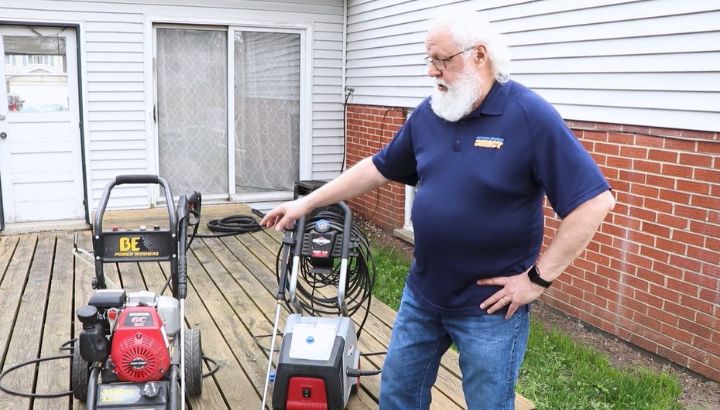
Electric pressure washers use between 1,200 and 2,000 watts, which is comparable to a hair dryer or small space heater. A typical 90-minute cleaning session costs between $0.25 and $0.50 in electricity at average US utility rates. Pressure washers do not use a lot of electricity relative to their cleaning output and session duration. Circuit requirements matter more than running cost since startup surge can reach 3,500 watts briefly on high-output models.
Electricity cost is rarely the reason someone hesitates before buying a pressure washer, but it comes up consistently once the machine is in use. The honest answer is that electric pressure washers are among the most energy-efficient outdoor power tools per unit of cleaning output delivered. This guide covers exact wattage figures by model tier, real session cost calculations, circuit sizing requirements, generator compatibility, and a direct comparison between electric and gas operating costs so every number you need is in one place.
What Determines How Much Electricity a Pressure Washer Uses
Two machine specifications determine electricity consumption: motor wattage and session duration. Everything else including PSI rating, GPM output, and brand is secondary to these two numbers for calculating actual energy use.
Motor wattage defines the rate of electricity consumption during operation. A 1,800-watt motor consumes 1,800 joules of electrical energy every second it runs under full load. Session duration multiplies that rate into a total kilowatt-hour figure that your utility bill reflects.
PSI output correlates loosely with wattage but is not a reliable predictor. A more efficient brushless motor can deliver equivalent PSI output at lower wattage than a brushed motor design. Always check the electrical specification label rather than estimating from PSI alone.
Running Watts Versus Startup Surge Watts
Running watts represent the continuous electrical consumption during active cleaning operation. This is the number used for circuit loading calculations and electricity cost estimates. It is the steady-state draw after the motor reaches full operating speed.
Startup surge watts represent the peak electrical demand during the brief motor acceleration period at startup. This surge lasts 1 to 3 seconds but can reach 2 to 3 times the running wattage. A 1,800-watt running machine may surge to 3,500 watts during startup.
Running watts answer the electricity cost question. Startup surge watts answer the circuit breaker and generator sizing question. Both numbers matter, but for completely different practical decisions.
How to Find Your Machine’s Exact Wattage
The wattage specification appears on the electrical rating label attached to the motor housing or near the power cord entry point on the machine body. It may be listed directly as watts, or as amps and voltage requiring a simple conversion.
Multiply the listed amperage by the voltage to calculate running watts. A label showing 15A at 120V means the machine draws 1,800 watts at full load. A label showing 12.5A means 1,500 watts.
If the label is missing or unreadable, the product manual and manufacturer website both carry the full electrical specification. Searching the model number plus “specifications” returns the correct figure for every current consumer model.
Actual Wattage Ranges Across All Consumer Electric Pressure Washer Tiers
Consumer electric pressure washers fall into three consistent wattage tiers that align directly with their PSI output range and intended application category.
Light-Duty Models: 1,200 to 1,500 Watts
Entry-level machines rated between 1,300 and 1,600 PSI draw 1,200 to 1,500 watts during continuous operation. These units handle vehicles, outdoor furniture, and light surface cleaning efficiently at a wattage comparable to a standard kitchen appliance.
Models including compact units from Sun Joe and Greenworks in this category operate comfortably on any standard 15-amp household circuit without approaching the circuit’s continuous load threshold. Their startup surge peaks at approximately 2,000 to 2,400 watts, which standard 15-amp circuit breakers handle without tripping under normal conditions.
Mid-Range Models: 1,500 to 1,800 Watts
Mid-range machines rated between 1,800 and 2,200 PSI draw 1,500 to 1,800 watts continuously. This tier covers the majority of residential cleaning tasks including driveways, decks, and siding, and their wattage approaches the practical continuous load limit of a shared 15-amp circuit.
Ryobi and Karcher residential models occupy this wattage tier primarily. Running a 1,800-watt machine on a 15-amp circuit rated for 1,800 watts maximum continuous load leaves zero margin for any other load sharing the same circuit, which is why a dedicated 20-amp circuit is strongly recommended for machines in this range.
High-Output Models: 1,800 to 2,000 Watts
The top tier of consumer electric machines, rated above 2,200 PSI, draws 1,800 to 2,000 watts continuously and requires a dedicated 20-amp circuit for reliable operation. Startup surge on these models peaks at 3,000 to 3,500 watts, which trips standard 15-amp breakers on shared circuits before the machine reaches operating speed.
Karcher K5 and K7 series models and high-output units from Westinghouse fall in this tier. For users asking does a pressure washer use a lot of electricity, these models draw the most, but even at 2,000 watts continuous, their hourly operating cost remains well under $0.30 at average US utility rates.
Calculating Exactly What Your Pressure Washer Costs to Run
The electricity cost calculation requires three inputs: machine wattage, session duration in hours, and local utility rate per kilowatt-hour. All three are straightforward to obtain and the math takes under one minute.
The Basic Cost Per Hour Formula
Divide the machine’s wattage by 1,000 to convert to kilowatts. Multiply kilowatts by your local utility rate per kilowatt-hour to get the cost per hour of continuous operation.
A 1,800-watt machine equals 1.8 kilowatts. At the US average utility rate of $0.14 per kilowatt-hour, the operating cost is 1.8 multiplied by 0.14, which equals $0.25 per hour. A 90-minute cleaning session on this machine costs $0.38 in electricity.
Even at premium utility rates above $0.25 per kilowatt-hour found in high-cost states including California and Hawaii, the same 90-minute session costs under $0.68. Electricity cost is not a meaningful financial factor in pressure washer ownership for residential users at any current utility rate.
Ryobi Vs Sun Joe Pressure Washer: Which Cleans Better?
Real Session Cost Examples by Machine Wattage
| Machine Wattage | Session Duration | kWh Consumed | Cost at $0.14/kWh | Cost at $0.25/kWh |
|---|---|---|---|---|
| 1,200 W | 60 minutes | 1.2 kWh | $0.17 | $0.30 |
| 1,500 W | 60 minutes | 1.5 kWh | $0.21 | $0.38 |
| 1,800 W | 90 minutes | 2.7 kWh | $0.38 | $0.68 |
| 2,000 W | 90 minutes | 3.0 kWh | $0.42 | $0.75 |
| 1,800 W | 3 hours | 5.4 kWh | $0.76 | $1.35 |
These figures confirm that even extended cleaning sessions on the highest-wattage consumer machines cost under $1.50 in electricity at the highest current US residential utility rates. Electricity cost is genuinely not a factor in the ownership economics of residential pressure washing.
Annual Electricity Cost for Regular Residential Use
A homeowner using a 1,800-watt pressure washer for 50 hours per year, which represents approximately one session per week through a six-month cleaning season, consumes 90 kilowatt-hours annually from pressure washer operation.
At $0.14 per kilowatt-hour, that annual consumption costs $12.60. At $0.25 per kilowatt-hour, it costs $22.50. Neither figure represents a meaningful line item in a household energy budget compared to the cleaning value delivered across those 50 operating hours.
Does a Pressure Washer Use a Lot of Electricity Compared to Other Appliances?
Putting pressure washer wattage in context against familiar household appliances answers the question more intuitively than abstract numbers alone. Most users are surprised by where the pressure washer falls in the household wattage hierarchy.
Wattage Comparison Against Common Household Appliances
| Appliance | Typical Running Watts | Context |
|---|---|---|
| Electric clothes dryer | 4,000 to 6,000 W | 2 to 3 times higher than pressure washer |
| Central air conditioner | 3,000 to 5,000 W | 1.5 to 2.5 times higher |
| Electric water heater | 3,000 to 4,500 W | Significantly higher |
| Hair dryer | 1,200 to 1,875 W | Nearly identical range |
| Microwave oven | 600 to 1,200 W | Lower than most pressure washers |
| Electric pressure washer | 1,200 to 2,000 W | Comparable to hair dryer |
| Vacuum cleaner | 500 to 1,200 W | Lower than most models |
| Laptop computer | 30 to 100 W | Dramatically lower |
A pressure washer draws roughly the same wattage as a hair dryer and significantly less than a clothes dryer or air conditioner. Most households run appliances at this wattage tier without concern.
The key difference is usage duration. A hair dryer runs for 5 to 15 minutes. A pressure washer session runs for 30 to 90 minutes. But even this difference produces total session costs well under $1.00 at any current utility rate, which confirms the electricity consumption is not excessive by any practical measure.
Electric Versus Gas Pressure Washer Operating Cost Comparison
Gas pressure washers eliminate electricity consumption entirely but replace it with fuel cost. A direct operating cost comparison shows that does a pressure washer use a lot of electricity becomes an even more favorable question when gas is the alternative.
A gas machine consuming 0.5 gallons per hour at $3.50 per gallon costs $1.75 per operating hour in fuel. An electric machine at 1,800 watts costs $0.25 per hour at average electricity rates. Over 50 operating hours per year, the gas machine costs $87.50 in fuel annually while the electric machine costs $12.50 in electricity.
The electric machine saves $75 per year in direct energy costs, plus additional savings from lower maintenance requirements, no oil changes, no carburetor service, and no fuel stabilizer needs. Over a five-year ownership period, energy cost savings alone approach $375 in favor of the electric model.
Circuit Requirements: Where Wattage Decisions Actually Matter
The practical importance of pressure washer wattage is not electricity cost but circuit compatibility. Choosing the wrong circuit or extension cord creates startup failures, mid-session breaker trips, and motor damage from sustained voltage drop.
Matching Machine Wattage to Circuit Capacity
A standard 15-amp residential circuit at 120V delivers a maximum of 1,800 watts. The National Electrical Code recommends limiting continuous loads to 80 percent of rated capacity, which means 1,440 watts sustained on a 15-amp circuit.
Machines drawing under 1,440 watts continuously operate safely on shared 15-amp circuits. Machines drawing 1,500 watts or more need a dedicated 20-amp circuit that provides 2,400 watts of continuous capacity with adequate headroom for the full motor load.
A 20-amp dedicated outdoor GFCI circuit is the recommended infrastructure for any machine rated 1,800 PSI or higher. This installation typically costs $150 to $300 through a licensed electrician and permanently eliminates circuit-related startup and mid-session breaker trip issues.
Extension Cord Wattage and Voltage Drop
An undersized extension cord creates resistance that drops voltage under load. When voltage falls below the motor’s rated input, the motor draws higher current to compensate, increasing actual watt consumption and generating excess heat in the windings.
Use 12-gauge outdoor-rated extension cords for any machine drawing more than 1,500 watts. Limit cord length to 25 feet maximum for 12-gauge wire. For runs beyond 25 feet, use 10-gauge cord to maintain voltage delivery under full motor load.
A 16-gauge indoor cord used on an 1,800-watt machine is not a minor inconvenience. It is a consistent source of thermal stress that shortens motor service life across every session it is used and can also cause nuisance breaker trips that appear to be machine faults.
Generator Sizing for Pressure Washer Operation
Running a pressure washer on a generator requires sizing the generator for startup surge rather than running watts. A generator sized only for running watts trips its overload protection every time the motor starts, making the unit appear undersized when it is simply mismatched.
Multiply the machine’s running watts by 2 to 2.5 to estimate startup surge requirement. A 1,800-watt machine needs a generator with at least 3,600 surge watts and 1,800 running watts rated capacity.
Inverter generators are particularly well-suited for pressure washer use because they produce clean sine wave power that matches utility grid quality. Modified sine wave output from standard generators can stress brushless motor controllers over time and cause premature controller failure on premium models.
Brushless Versus Brushed Motor Efficiency and Electricity Consumption
Motor design affects both electricity consumption and machine longevity. Understanding this difference helps explain why two machines with identical PSI ratings can have noticeably different wattage specifications.
How Brushless Motors Reduce Watt Draw
A brushless motor converts electrical energy to mechanical output more efficiently than an equivalent brushed motor. The elimination of carbon brush friction and commutator electrical losses means less input wattage is lost as heat for every watt delivered as pump output.
At the same PSI and GPM rating, a brushless motor machine typically draws 10 to 15 percent fewer watts than a brushed motor equivalent. A brushed motor machine drawing 1,800 watts might be replaced by a brushless design drawing 1,550 watts at identical cleaning output.
This efficiency advantage compounds over a full operating season. A 200-watt reduction in draw across 50 operating hours per year saves 10 kilowatt-hours annually. The financial saving is small at current utility rates, but the reduced heat generation extends motor winding service life significantly more than the cost saving alone would suggest.
Which Models Offer Brushless Motor Efficiency
Ryobi offers brushless motor options in their upper residential tier, including the RY803001 model, which delivers 2,000 PSI at reduced wattage compared to equivalent brushed models in their lineup.
Greenworks incorporates brushless motors across their Pro series lineup, and these models carry extended warranties that reflect the manufacturer’s confidence in brushless motor longevity relative to brushed alternatives.
The brushless premium typically adds $50 to $100 to the purchase price within the same performance tier. For users who clean regularly and plan to keep the machine for five or more years, the efficiency and longevity advantage justifies this premium clearly.
Frequently Asked Questions
Does a pressure washer use a lot of electricity compared to other appliances?
No. An electric pressure washer draws 1,200 to 2,000 watts, which is comparable to a hair dryer and significantly less than a clothes dryer or central air conditioner. A typical 90-minute cleaning session consumes 2 to 3 kilowatt-hours of electricity.
At the US average utility rate of $0.14 per kilowatt-hour, that session costs between $0.28 and $0.42. Even at premium rates above $0.25 per kilowatt-hour, the same session costs under $0.75. Electricity cost is not a meaningful ownership expense for residential pressure washer users at any current utility rate in North America.
How many kilowatt-hours does a pressure washer use per session?
A standard 90-minute cleaning session on a 1,800-watt machine consumes 2.7 kilowatt-hours. A 60-minute session on a 1,500-watt machine consumes 1.5 kilowatt-hours. A 3-hour extended session on a 2,000-watt machine consumes 6 kilowatt-hours.
For context, the average US household uses approximately 30 kilowatt-hours per day across all appliances. A 90-minute pressure washer session represents less than 10 percent of typical daily household consumption, confirming that pressure washers do not meaningfully impact residential electricity bills even with weekly use throughout a full cleaning season.
How much does it cost to run an electric pressure washer for one hour?
Running an 1,800-watt pressure washer for one hour at the US average electricity rate of $0.14 per kilowatt-hour costs $0.25. At a higher rate of $0.25 per kilowatt-hour found in some states, the same hour costs $0.45.
Light-duty 1,200-watt models cost $0.17 per hour at the average rate. High-output 2,000-watt models cost $0.28 per hour. Over a full year of typical residential use at 50 hours of operation, total electricity cost ranges from $8.50 for the lightest models to $14.00 for the heaviest consumer units at average national rates.
What size circuit breaker do I need for an electric pressure washer?
A 20-amp dedicated circuit is recommended for any machine drawing 1,500 watts or more continuously. The National Electrical Code recommends limiting continuous loads to 80 percent of circuit capacity, which means a 15-amp circuit safely handles only 1,440 watts sustained.
Machines drawing under 1,440 watts can share a standard 15-amp circuit with minimal loads. Machines drawing 1,500 to 2,000 watts need a dedicated 20-amp circuit to operate without nuisance breaker trips on startup or during extended sessions. A GFCI-protected dedicated 20-amp outdoor outlet handles every current consumer electric pressure washer model without capacity issues.
Can I run an electric pressure washer on a generator?
Yes, but the generator must be sized for startup surge rather than running watts alone. Multiply the machine’s running wattage by 2 to 2.5 to estimate startup surge demand. A 1,800-watt machine requires a generator with at least 3,600 surge watts for reliable startup without overload trips.
An inverter generator produces clean sine wave power that matches utility grid quality and works correctly with all brushless motor pressure washer controllers. Standard open-frame generators produce adequate power for brushed motor machines but can stress brushless controllers over extended use. Always add 15 to 20 percent margin above the calculated surge requirement when selecting a generator.
Is an electric pressure washer cheaper to run than a gas pressure washer?
Yes, significantly cheaper per operating hour. An electric machine at 1,800 watts costs approximately $0.25 per hour at average US electricity rates. A gas machine consuming 0.5 gallons per hour at $3.50 per gallon costs $1.75 per hour in fuel alone.
Over 50 operating hours per year, the gas machine costs $87.50 annually in fuel while the electric machine costs $12.50 in electricity. The electric machine saves $75 per year in direct energy costs plus additional savings from lower maintenance requirements including no oil changes, no spark plug replacement, and no carburetor servicing.
Does pressure washer wattage affect cleaning performance?
Wattage powers the motor that drives the pump. Higher wattage within the same motor design generally produces higher pump output, which contributes to higher PSI and GPM at the nozzle. However, wattage and cleaning performance do not scale in a simple linear relationship.
Motor efficiency, pump design, and nozzle geometry all influence output independently of wattage. A more efficient brushless motor delivers equivalent PSI at lower wattage than a less efficient brushed design. Use PSI and GPM specifications to compare cleaning capability between models, and use wattage specifications for circuit sizing and electricity cost calculations only.
Will a pressure washer increase my electricity bill noticeably?
No. A pressure washer used for 50 hours per year at 1,800 watts consumes 90 kilowatt-hours annually. At $0.14 per kilowatt-hour, this adds $12.60 to your annual electricity bill. Even at $0.25 per kilowatt-hour, the annual addition is $22.50.
For reference, a central air conditioner running 8 hours per day for three months consumes approximately 1,440 kilowatt-hours over that period. The pressure washer’s annual consumption is less than 7 percent of the air conditioner’s summer consumption alone. Pressure washer electricity use is not detectable as a separate line item in any typical residential utility bill.
Does leaving a pressure washer plugged in use electricity when not running?
No. Electric pressure washers draw zero electricity when switched off and plugged in. Unlike devices with standby modes, sleep states, or indicator lights, a pressure washer has no electronics that consume power when the machine is not actively operating.
Unplugging the machine between sessions is a good safety practice in wet outdoor environments because it eliminates any potential for a fault developing at the outlet connection in wet conditions. But leaving the machine plugged in does not consume measurable electricity or add to your electricity bill in any way when the machine is switched off.
Conclusion
Does a pressure washer use a lot of electricity? No. Consumer electric models draw 1,200 to 2,000 watts continuously, comparable to a hair dryer, and a typical cleaning session costs between $0.25 and $0.75 in electricity at any current US utility rate.
The practical importance of wattage lies in circuit sizing and generator selection, not operating cost. A dedicated 20-amp GFCI circuit handles every consumer model without capacity issues, and a generator sized at 2.5 times the running wattage handles startup surge reliably.
Electric pressure washers cost 7 times less per hour to operate than equivalent gas models when fuel and electricity prices are compared directly. For any homeowner choosing between gas and electric, operating cost is a decisive financial argument in favor of the electric option at every current energy price level.